


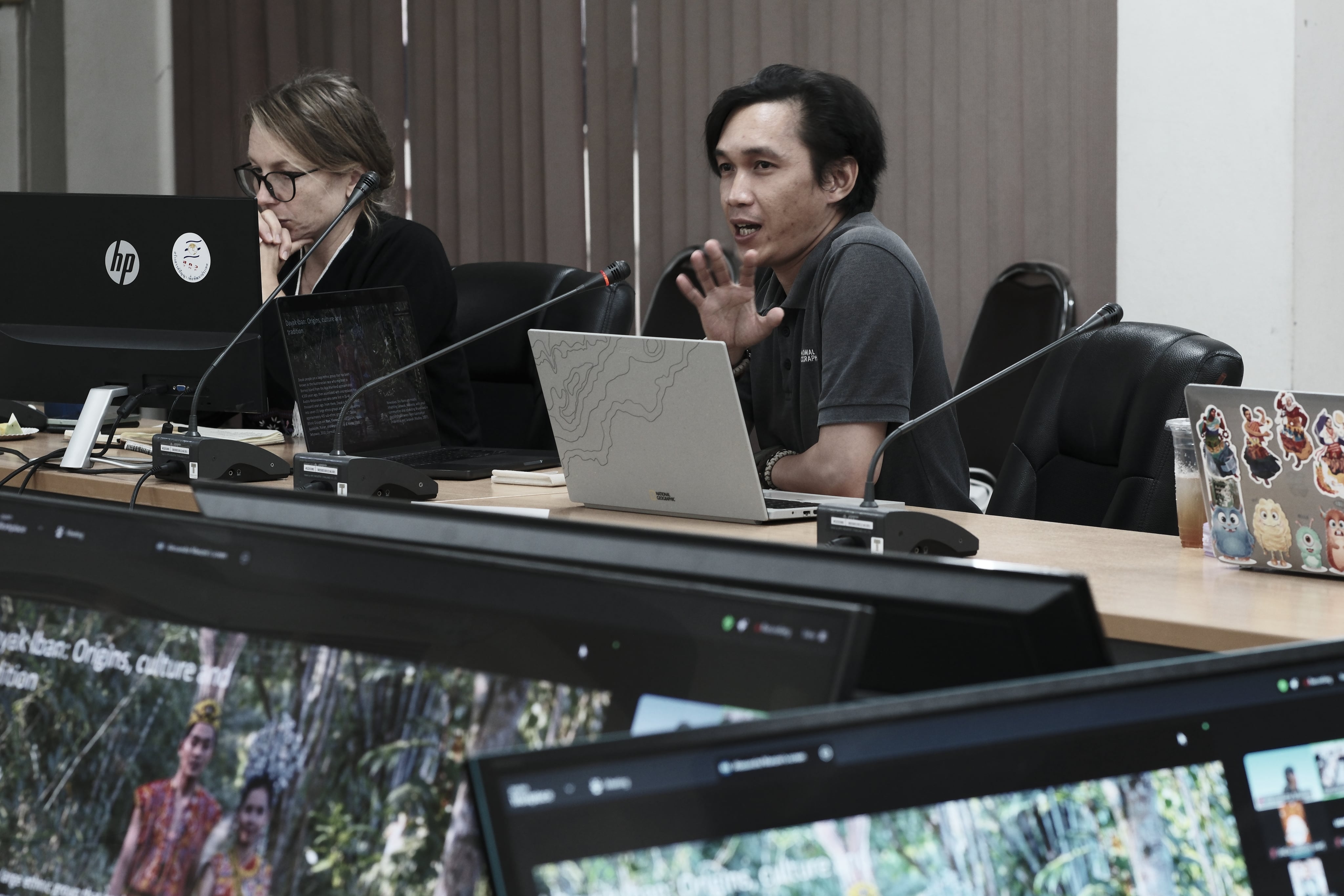
An international symposium successfully concluded today at Chiang Mai University. The event brought together distinguished scholars, conservation leaders, and Indigenous practitioners to address the full recognition of Indigeneity as a powerful, relational way of knowing and stewarding the Earth. The event spoke to global conservation policy makers in a crucial moment for the forestry week happening in Chiang Mai and COP 30 starting next week.
The symposium entitled "State-of-the-art on Heritage conservation policies of Sacred Forests and Spiritual Landscapes in the Indo-Burma Biodiversity Hotspot and Southeast Asia’s Terrestrial Ecoregions" took place at Chiang Mai University and involved 30 participants situated in more than 20 countries on 5 continents. The event was organized by Dr. Alessandra Manzini of the PLACES Lab, CY Cergy Paris University under the SPIRAL project (founded by the EUTOPIA SIF alliance) and linked to the BA Heritage Project (funded by the British Academy), led by Dr. Marco J Haenssgen at Chiang Mai University.
The attendees of event included leading researchers and scholars The symposium featured a distinguished lineup of speakers, including Dr. M.K.S. Pasha (IUCN Asia Regional Coordinator), Prof. B.K. Tiwari (North-Eastern Hill University, India), Prasert Trakansuphakorn (Pgakenyaw Association for Sustainable Development, Thailand), Assistant professor Dr. Koustab Majumdar (RKMVERI, India & York University, Canada), Sandy Leo (University of Indonesia), Nining Liswanti (CIFOR–ICRAF), Dr. Ashley Massey Marks (School of the Holy Child), Dr. Alison Ormsby (Adventure Scientists), Dr. Pao Vue (USDA Forest Service), Dr. David Hecht (University of Georgia), Dr. Alexander Greene, Dr. Lily Zeng (Government of Canada), and Assistant Professor Dr. Suwichan (Ethnic Wisdom Foundation, Thailand). Together, they represented a rich diversity of academic expertise and Indigenous knowledge systems from across Asia and beyond, offering powerful insights into how culture, spirituality, and ecology are interwoven in shaping sustainable futures.
Keynote speaker and internationally recognized scholar Prof. Shonil Bhagwat (The Open University, UK) highlighted from the outset of the symposium the conservation relevance of cultural landscapes: “Sacred forests systems possess multiple properties of deep antiquity, often spanning several centuries, fostering an unmatched resilience and acting as persistent reservoirs of biocultural diversity. These spiritual sites represent the oldest protected areas in the world, predating modern state-based conservation by millennia.”
The organizer of the event, Dr Alessandra Manzini from CY Cergy Paris University in France, stressed the significance of embracing Indigenous peoples’ ecological practices in global conservation: “The uniqueness and diversity of Cosmoecologies entangled with sacred forests have both spatial and practical implications for everyday livelihoods. They reflect shifts in value systems; therefore. The symposium aims to highlight how indigeneity should be embraced through adaptive, heritage-sensitive policy frameworks that prioritize biocultural balance as a key foundation for conservation goals.”

Dr. Manzini set the goal to practice a decolonial research process by looking at how sacred forests ecosocial realities and their complex, entangled relationships of the 12 small-scale societies tell us what adaptive heritage sensitive relational governance works, rather than imposing external conservation models. However, while the value of IPLC stewardship is globally acknowledged, the symposium stressed the extreme and growing challenges, they face in maintaining their heritage practices and self-determination. Three main interconnected constraints emerged as a call to action for policymakers:
- Land and Policy Insecurity: The Enclosure of Ancestral Domains and eviction of IPLCs
- State-driven spatial planning often legally encloses ancestral lands within state-designated categories (e.g., national parks), effectively criminalizing livelihood of traditional land users on the lands they have stewarded for millennia.
- This insecurity directly undermines the ability of IPLCs to enforce their customary laws - the everyday heritage practices - because the state framework now holds superior, often contradictory, legal authority.
- The Bureaucratic Struggle for Recognition an Identity Straitjacket:
- National governments often use rigid, restrictive, or non-existent definitions of "Indigenous," creating an administrative "catch-22." Without formal recognition, groups cannot access legal protections or assert rights over their spiritual landscapes
- Even when states attempt to recognize sacred sites, the strict criteria used in policy documents often prevent the recognition of traditional sites due to problems of form, reinforcing why customary laws are more effective in their design and execution within cohesive small-scale societies.
- The Constraint of International Law: A Non-Binding Promise
- Major international conventions like UNDRIP and ILO 169 are often non-binding at the national level. Groups are therefore forced to appeal primarily at the restrictive national level, where policy translates into land loss and criminalization.
- International definitions often rely on inflexible criteria tied to a specific territory, failing to account for the complex and fluid identities and historical mobility of various groups, thus undermining the very rights they aim to protect.
Key takeaways
The resounding points that came up multiple times in different ways are that:
- Spirituality imbues the landscapes of local indigenous and non-indigenous communities across Asia
- The power of belief systems and rituals (such as worshipping the deity and the surrounding forest) is what enforces protection.
- These spiritual landscapes, sites and relations are nonetheless difficult to measure, map, or depict using external frameworks
- The relationalities communities share with spiritual entities and spaces are flexible and under constant reinterpretation, especially under the influence of economic pressures, tourism and state power, and that
- The best way to uphold these spiritual practices and spaces is by supporting existing local institutions.
The consensus of the symposium was aligning around the recognition of the fact that Policy supporting sacred landscapes should uphold local institutions rather than impose external legal frameworks especially if they have conserved biocultural values for many centuries.
Looking Ahead
The symposium confirmed that embracing Indigeneity as a relational way of knowing and living is the scientifically proven strategy for achieving robust biodiversity conservation and ecological stability. Organizers look forward to future collaborative research that continues to challenge mainstream conservation practices and promote the vital role of sacred forests and spiritual landscapes in global sustainability.
- Statutory law is more effective when it recognizes that customary laws - which restrict access to core breeding areas, regulate harvesting periods, and govern the use of medicinal herbs - are legally binding and supersede state regulations within designated biocultural zones, provided they demonstrably uphold conservation objectives.
- would involve a participatory process to map and officially recognize Spiritual Landscapes and their associated rules (e.g., Taboos or Seasonal Restrictions) as legitimate, locally enforced conservation measures governed by local institutions which have the ecological knowledge to regulate and calibrate norms by everyday interrelating to such an adaptive system.
Boiler Plate
The success of sacred forest conservation lies in moving toward models of polycentric relational adaptive governance. This involves the full recognition of the agency of both human and 'more-than-human' elements (spirits, ancestors, nature) in governance systems based on indigenous epistemologies. This relational aspect is essential to achieving a moral balance that ensures reciprocal environmental care and effective biocultural conservation. Customary laws - restricting access to core areas and regulating harvesting - are rooted in a daily, multi-sensorial observation of the multispecies environment, hence the best way to uphold these spiritual practices and spaces is by supporting existing local institutions.
Dr. Haenssgen provided a definition of Heritage-Sensitive Conservation Policy. This framework embraces the notion that heritage - understood as the concrete, everyday performance of culture - is central to community life and links people to ecosystems. It recognizes biocultural heritage, acknowledging that humans and ecosystems are inseparable. As a socially critical and activist research agenda, this policy approach supports communities and their cultural practices (everyday heritage) directly, or indirectly by removing systemic barriers to their engagement with the environment.
The BA Heritage Project
“Towards Heritage-Sensitive Climate Change Mitigation Policy: Impulses from Indigenous Practice in Thailand” is a British Academy funded project (grant ref. IOCRG\101013) hosted by Chiang Mai University and led by Dr Marco J Haenssgen. Operating from June 2024 to March 2026, this project trials co-developed and heritage-sensitive forest conservation approaches to identify effective mechanisms that can help support the critical role of Indigenous peoples in climate change mitigation in the tropics.
The SPIRAL Project
SPIRAL project: cross-cultural studies spiritual landscapes sustainable management practices -founded by the EUTOPIA SIF alliance (grant agreement 945380). It is examining the management of sacred forests and their cosmoecologies across 72 societies, with main in-depth case studies in Indo-Burma (Northern Thailand) and the Diola territories in Lower Casamance (South Senegal Northern Guinea-Bissau), it will explore in depth another case study in Tropical Andes. The project aims to transform how we look at sustainability by integrating perspectives from multiple relational ontologies and eco-spiritual practices, exploring how these worldviews can contribute to achieving biocultural diversity targets.
Enquiries
Dr Alessandra Manzini, CY Cergy Paris University, alessandra.manzini@cyu.fr
Dr Marco J Haenssgen, Chiang Mai University, marco.haenssgen@cmu.ac.th
Dr Navaporn Sunanlikanon, Chiang Mai University, navaporn_sun@cmu.ac.th
www.facebook.com/tcijthai
Tags


